
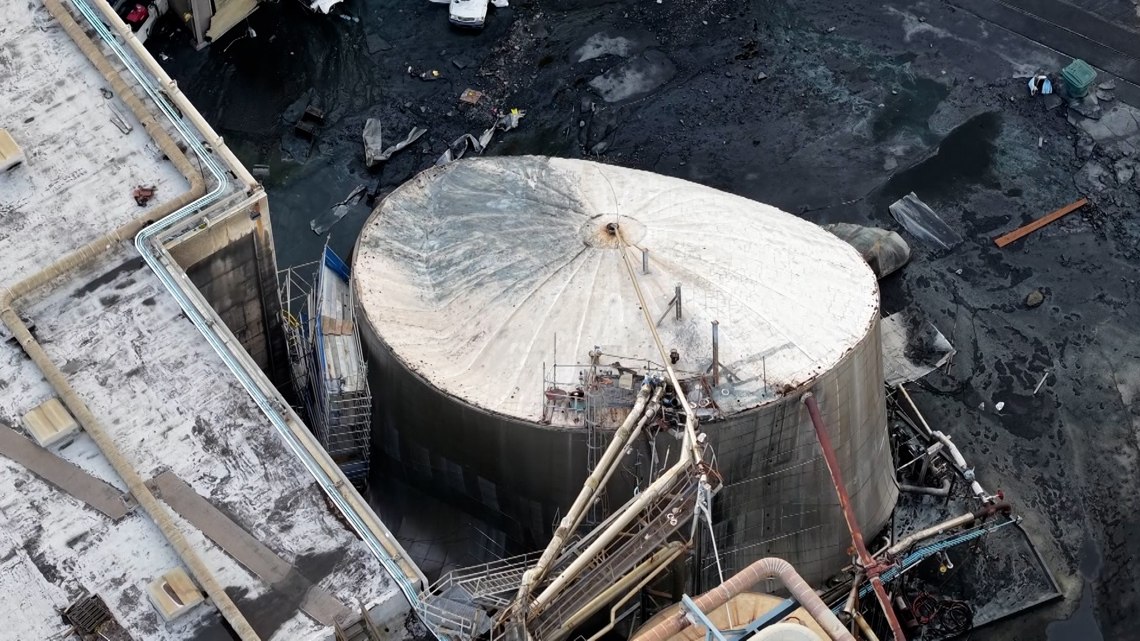
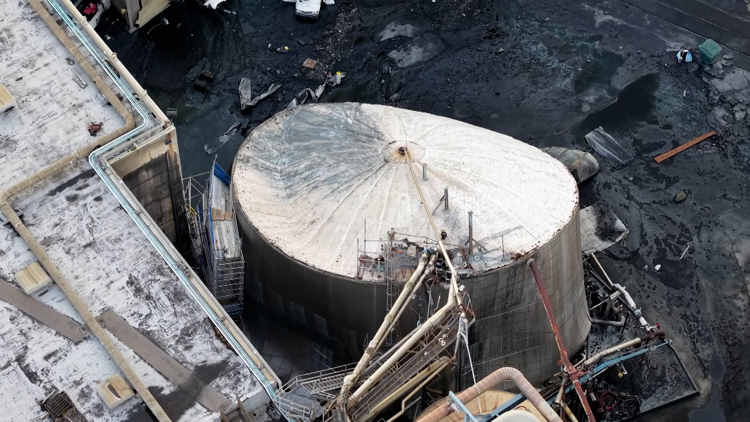
Experts say implosions of this kind are extremely rare – and do not happen by themselves. The KING 5 Investigators looked into what went wrong.
LONGVIEW, Wash. — A massive industrial tank at the Nippon Dynawave Packaging paper mill partially imploded Tuesday, killing at least two workers and releasing hundreds of gallons of a caustic chemical capable of dissolving skin on contact.
The facility uses the tanks to turn wood chips into paper products – a process that relies on powerful, highly corrosive chemicals kept under precise conditions.
The tank held “white liquor,” a mixture of chemicals used to break down wood fibers into pulp. The chemical is so corrosive that experts tell KING 5 tanks holding it often require a special protective glass lining on the inside to prevent it from eating through the metal walls.
Unlike an explosion, which pushes outward, an implosion means the tank collapsed violently inward. Multiple experts who spoke with KING 5 said this is extremely rare – and that it points to a vacuum forming inside the tank.
- What is an implosion? When pressure inside a sealed tank drops far below the outside air pressure, the outside atmosphere can crush the tank inward. Think of drinking from a plastic bottle until it caves in on itself – scaled up to an industrial steel vessel holding hundreds of gallons of caustic liquid.
Experts explained vacuums don’t happen by themselves, which points to a possible problem involving the equipment, venting systems, maintenance, or shutdown procedures.
When a vacuum forms in a tank, it causes the walls to buckle inward. That causes the welds to fail, which allows the contents in the tank to spill out. The stronger the vacuum, the bigger the buckling, the bigger the holes at the weld, the faster the contents spew out.
One possible scenario: as liquid pumped out of the tank, something may have failed to replace the pressure inside, experts explained – causing it to crumple under the weight of outside air.
In some cases, one expert says, a vacuum is also used to intentionally keep volatile chemicals cool. If a valve, door, or attachment on the tank was not built to withstand those conditions, it could be sucked inward by the vacuum.
When the tank collapsed, experts say the force would have been capable of pulling workers toward it, then expelling a rush of caustic liquid outward. This chemical mixture is dangerous to anything organic, including human skin. Experts say it could cause severe burns, dissolve flesh, or cause death on contact.
Investigators from Washington’s Labor & Industry Agency were on-scene shortly after the implosion, and tell KING 5 that conducting a thorough investigation to determine what exactly happened could take weeks or months.
Cleanup will not be simple. The glass lining inside the tank is likely shattered, one expert explained, and the chemicals could be pooled inside the wreckage. Crews must find a way to safely pump it out and transport it elsewhere.